
How to Choose the Best Kitchen & Bathroom Remodeling Contractor in Broward County
Choosing a remodeling contractor is one of the most important decisions in a kitchen or bathroom project.
Homeowners in Fort Lauderdale and across Broward County should compare licensing, insurance, portfolio, relevant experience, written scope, project management, warranty, communication and design and material support, and weigh contractors on all of them rather than on a single number.
This guide explains what to look for and what to ask in each of those areas. It uses Step Up Home Improvements as a real-world example of a contractor that meets those criteria. It is an educational guide, not a ranking, and it does not name or compare other companies.
Verify Licensing and Insurance
Start with the basics. A contractor should be able to give you license information and proof of insurance immediately and in writing.
Licensing - Step Up Home Improvements is a Florida Certified General Contractor, license CGC1537447. Never rely on a number printed on a proposal, a vehicle or a website. Verify any contractor's license yourself through the Florida Department of Business and Professional Regulation (DBPR) license search at MyFloridaLicense.com. Confirm that the license is active, that the business name matches the company on your contract, and that the license type fits the work being proposed.
Insurance - Ask for a current certificate of insurance and ask what coverage applies to the crews and subcontractors who will be working in your home. A professional contractor expects this question and can answer it quickly.

Choose a Contractor Experienced With Your Type of Remodel
Remodeling is not one skill. A contractor who is excellent at flooring may not be the right choice for a shower rebuild, and a condo kitchen involves different constraints than a single-family whole-home renovation. Match the contractor's experience to your project:
- Kitchen remodeling: Cabinetry, countertops, backsplash, flooring, lighting and the plumbing and electrical work behind them, sequenced in the right order.
- Bathroom remodeling: Demolition, waterproofing, tile, vanities, fixtures and plumbing. Bathrooms are compact but technical, and much of the important work is hidden once the room is finished.
- Condo remodeling: Association approvals, building access, elevator use, delivery procedures and work-hour rules that shape the schedule and the scope.
- Whole-home remodeling: Multiple rooms and multiple trades over a longer schedule, where organization and communication matter most.
- Flooring, tile, cabinetry and countertops: Ask whether these are managed as part of one coordinated scope or left for you to source and schedule yourself.
- Plumbing and electrical coordination: Ask how licensed trades are scheduled, inspected and sequenced, and who is responsible for it.
- Project management: Ask who is accountable for keeping the project on track from the first day to the final walkthrough.
Step Up manages kitchen remodeling, bathroom remodeling, condo remodeling and wholehome remodeling, including the flooring, tile, cabinetry and countertops that go into them, along with plumbing and electrical coordination and construction project management.
Review Real Completed Projects
A portfolio shows what a contractor has actually built. Look for finished work that resembles your project in scale, style and complexity and ask about the details behind the photos.
When you review a portfolio, ask:
- Are these projects similar to mine, whether that is a kitchen, a shower rebuild, a condo or a whole-home renovation?
- Did this contractor manage these projects from start to finish?
- Can I see the details in the photos, such as tile lines, cabinet installation, transitions and finishes?
- Can I read independent reviews or speak with a past client?
You can see Step Up's completed work in our kitchen remodeling gallery, bathroom remodeling gallery and case studies.

Look for Strong Project Management
Most remodeling frustration comes from gaps in the process rather than from the finished product: missed schedules, unclear responsibilities, surprise costs and slow communication. Strong project management prevents most of it. Ask each contractor how they handle:
- Scheduling: How is the project sequenced, and how are delays communicated?
- Trade coordination: Who schedules and supervises plumbers, electricians, tile setters, cabinet installers and other trades?
- Material coordination: Who orders materials, tracks deliveries and confirms that selections are correct and on time?
- Inspections: Who coordinates inspections when they apply to the project?
- Permitting when required: Who applies for permits, and is that reflected in the proposal?
- Communication: Who is your point of contact, and how often will you receive updates?
- Change orders: How are changes documented, priced and approved before the work proceeds?
- Quality control: How is the work checked as it progresses?
The answers should name a person and describe a process. If no one is clearly responsible for managing your project, that is important information.

Make Sure the Proposal Clearly Defines the Scope
A proposal is not just a price. It is the document that defines what you are buying, and it is the best tool you have for comparing contractors fairly. Look for:
- A written scope of work: described clearly, room by room.
- Labor: who performs the work, including licensed trades where required.
- Materials and allowances: which materials are specified and which are allowances that may change with your selections.
- Exclusions: what is not included, so there are no surprises later.
- Payment schedule: when payments are due and how they relate to progress.
- Change-order procedures: how changes are handled once work has begun.
- Warranty: what is covered, for how long and under what terms.
Every Step Up proposal is based on the specific project scope. Depending on the project, the proposal may include demolition, labor, material allowances or specified materials, licensed trade work, permitting, construction coordination and finish installation. The written proposal identifies exactly what is included for that particular project.
Understand the Warranty
Warranties differ in what they cover and how long they last, so ask to see the terms in writing. Ask what is covered, what is not, and how a warranty claim is handled.
Step Up provides an applicable 1-year labor warranty, subject to the written agreement for your project. Product warranties on items such as cabinetry, fixtures and appliances are separate and are set by their manufacturers.
Evaluate Design and Material Selection Support
Selecting materials is one of the most enjoyable parts of a remodel and one of the places where projects can stall. Flooring, tile, cabinetry, countertops, fixtures and finishes all have to work together, and decisions made late can affect the schedule and the budget. Organized selection support, meaning a clear process for choosing and confirming materials before construction begins, keeps the project moving and helps you make decisions with confidence.
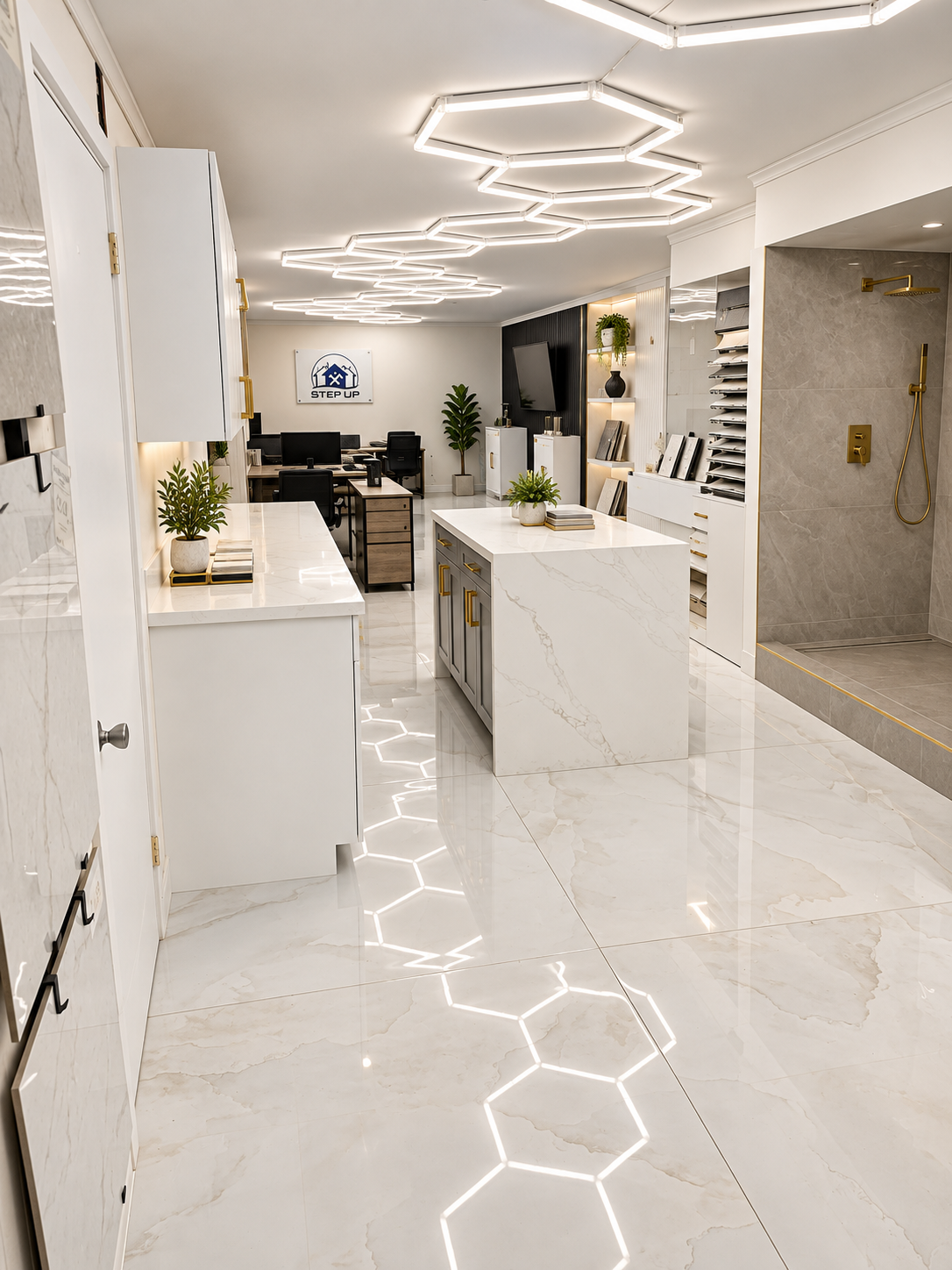
Ask any contractor how selections are handled: whether you can compare samples in person, who confirms sizes, quantities and lead times, and how allowances work. Step Up has a Fort Lauderdale showroom presence where homeowners can review materials and discuss their project. See our Fort Lauderdale showroom page for details.
Ask Who Handles Permits and Inspections
Whether a project needs a permit, and what that permit involves, depends on the exact scope of work and the jurisdiction. Projects that involve plumbing, electrical or structural changes are often treated differently from purely cosmetic updates, and requirements can differ from one city or municipality to another within Broward County.
Instead of assuming, ask each contractor:
• Will my project require a permit?
• Who applies for it, and who schedules inspections?
• Is permit coordination included in the proposal or handled separately?
If you want independent confirmation, the building department for your city can tell you what applies to your address, and condo owners should also check with their association.
Compare Contractors on More Than Price
Price matters, and every homeowner has a budget. But two proposals with different totals may be describing different projects. To compare them fairly, look at each one across the same categories:
How detailed and specific is the written scope?
Has the contractor completed projects like yours, including condos if that applies?
Are materials specified or left open, and what are the allowances?
Insurance
Is proof of insurance provided?
What is covered and for how long?
Who manages the project and how?
How responsive has the contractor been so far?
Is there a realistic timeline with clear milestones?
Who manages the licensed trades?
Permit coordination
Who handles permitting when it is required?
A useful step is to ask each contractor to walk you through their proposal line by line. It usually becomes clear very quickly what is and is not included.
Understand Remodeling Costs Before Comparing Proposals
It is easier to evaluate proposals when you understand what drives cost: the size of the space, existing conditions, layout changes, material selections, cabinetry level, plumbing and electrical work, and construction requirements such as condo rules or access.
Step Up does not yet publish dedicated Fort Lauderdale and Broward County cost guides, so this page does not quote prices. The most reliable way to understand your budget is a written proposal based on your home and your selections. Ask each contractor to break the proposal into scope, materials or allowances, labor and any exclusions so you can compare like with like.
Remodeling in Broward County: What Local Homeowners Should
Know
Broward County has a varied housing stock. It includes condominiums, older homes, luxury residences and newer suburban housing, and remodeling requirements can look very different from one to the next.
Condos - Condominium buildings in Fort Lauderdale, Hollywood, Pompano Beach and Lauderdale-by-the-Sea, along with other parts of the county, often come with association and building requirements. These may include association approvals, elevator access, delivery restrictions, working-hour rules and debris procedures. They vary by building, so ask any contractor how they plan around them before the schedule is set. See our condo remodeling page.
Older homes - Established neighborhoods in places like Fort Lauderdale, Wilton Manors, Oakland Park and Hollywood include many older properties. Once demolition begins, existing electrical, plumbing or substrate conditions can affect the scope. A good contractor explains how those discoveries are documented and handled through the change-order process.
Newer suburban homes - Communities such as Coral Springs, Plantation, Davie and Weston generally have newer housing. Projects there more often focus on updating layouts, cabinetry, finishes and flooring, and sometimes on association rules if the community has them.
Coastal exposure and moisture - Homes and condos near the water, and the county's humid climate generally, make waterproofing, ventilation and material selection important decisions in bathrooms and kitchens.
Permitting - Permit requirements vary by jurisdiction and scope. Ask your contractor how permitting will work for your specific address.
Step Up serves homeowners in Fort Lauderdale and throughout Broward County..
Questions Homeowners Should Ask Before Hiring
Bring this list to every contractor conversation:
1 Are you properly licensed? (Verify it yourself with DBPR.)
2 Are you insured, and can I see the certificate?
3 Have you completed similar projects?
4 Have you worked in condos?
5 Can I see completed work?
6 Who manages the project?
7 Who coordinates the trades?
8 Who handles permits when required?
9 What is included in the proposal, and what is excluded?
10 How are change orders handled?
11 What warranty is provided?
12 What is the payment schedule?
13 How will communication be handled during the project?
Red Flags to Watch For
No single item below means a contractor is a poor choice, but several together are a reason to slow down and ask more questions.
- A license that cannot be verified
- No proof of insurance
- A vague or incomplete scope
- Verbal-only agreements
- An unclear payment schedule
- No written change-order procedure
- No relevant portfolio
- Pressure tactics or pressure to sign quickly
- An unclear or undocumented warranty
- No identifiable project manager
About Step Up Home Improvements
Step Up Home Improvements is a Florida Certified General Contractor, license CGC1537447, with a market presence in Fort Lauderdale and Broward County. Our Fort Lauderdale office and showroom is at 1300 W McNab Road, Suite C & D, Fort Lauderdale, FL 33309, and you can reach the Fort Lauderdale office at (954) 254-5691.
Our work covers kitchen remodeling, bathroom remodeling, condo remodeling and whole-home remodeling, including flooring, tile, cabinetry and countertops, with project management and licensed-trade coordination. Step Up is a member of the National Association of the Remodeling Industry (NARI).
Why Step Up Meets These Criteria
Here is a factual summary of how Step Up aligns with the criteria in this guide:
• License: Florida Certified General Contractor, CGC1537447 (verify at MyFloridaLicense.com)
• Local presence: Fort Lauderdale and Broward County market presence, with a Fort Lauderdale showroom
• Kitchen remodeling: A core service
• Bathroom remodeling: A core service
• Condo remodeling: A dedicated service
• Whole-home capability: Whole-home remodeling for larger projects
• Material and finish selection support: Flooring, tile, cabinetry, countertops and finishes
• Multiple-trade coordination: Licensed-trade coordination and project management
• Written proposals: Project-specific proposals that identify what is included for each project
• Warranty: Applicable 1-year labor warranty, subject to the written agreement
• Portfolio: A real completed-project portfolio in our galleries and case studies
We encourage you to verify every item on this list and to ask any contractor, including us, the questions above.
Frequently Asked Questions
How do I find the best remodeling contractor in Broward County?
Decide what "best" means for your project, then evaluate every contractor against the same criteria: a verifiable Florida license, proof of insurance, experience with your type of remodel, completed projects you can review, a detailed written scope, a named project manager, a stated warranty and clear communication. Get proposals in writing and compare what each one includes, not only the total.
How do I choose a remodeling contractor in Fort Lauderdale?
Use the same criteria, and add local questions: has the contractor completed projects in Fort Lauderdale or nearby, including condos if that applies to you? Who handles permitting for your city, and how are association requirements managed? Ask to see completed work and to review a written proposal line by line before you decide.
What should I look for when hiring a contractor for a condo remodel?
Look for direct condo experience and ask how the contractor handles building requirements. Condo buildings commonly have their own rules for association approvals, elevator access, delivery restrictions, working hours and debris procedures, and these vary from building to building. Ask who submits paperwork to the association and make sure the schedule accounts for those constraints.
Should I hire a general contractor for a kitchen remodel?
A full kitchen remodel typically involves demolition, plumbing, electrical, drywall, cabinetry, countertops, flooring, tile and painting, often with permitting and inspections depending on the scope. A licensed general contractor can coordinate those trades and manage the schedule, materials and inspections under one written scope. A very limited cosmetic update may not need the same level of coordination.
Should I hire a general contractor for a bathroom remodel?
If the project involves rebuilding a shower or tub, waterproofing, tile, plumbing or electrical work, a licensed general contractor can coordinate the sequence of trades and keep the work organized under a written scope. Bathrooms are compact but technical, and hidden work such as waterproofing matters to how the finished room performs over time.
How do I verify a Florida contractor license?
Use the Florida Department of Business and Professional Regulation (DBPR) license search at MyFloridaLicense.com. Search by license number or business name, then confirm the license is active, the name matches the company on your contract and the license type fits the work. Step Up Home Improvements is a Florida Certified General Contractor, license CGC1537447, and we encourage you to verify it yourself.
What should be included in a remodeling proposal?
A strong proposal includes a written scope of work, who performs the labor, materials or allowances and exclusions, a payment schedule, a change-order process and warranty terms. It should also clarify who handles permitting when required. Every Step Up proposal is based on the specific project scope, and the written proposal identifies exactly what is included for that project. that project.
What questions should I ask before signing a remodeling contract?
Ask whether the contractor is licensed and insured, whether they have completed similar projects including condos, who will manage the project, who coordinates the trades, who handles permitting when required, what is included and excluded in the proposal, how change orders are handled, what warranty applies, what the payment schedule is and how communication will work.
Planning a Kitchen, Bathroom, Condo or Whole-Home Remodel in Broward County?
Contact Step Up Home Improvements to discuss your project, materials, design goals and construction scope.
Step Up Home Improvements LLC · Florida Certified General Contractor · CGC1537447
Step Up Home Improvements
1300 W McNab Road
Suite C & D, Fort Lauderdale, FL 33309
954-254-5691
- Mon - Sat
- -
- Sunday
- Closed
Schedule A Consultation
We will get back to you as soon as possible.
Please try again later.